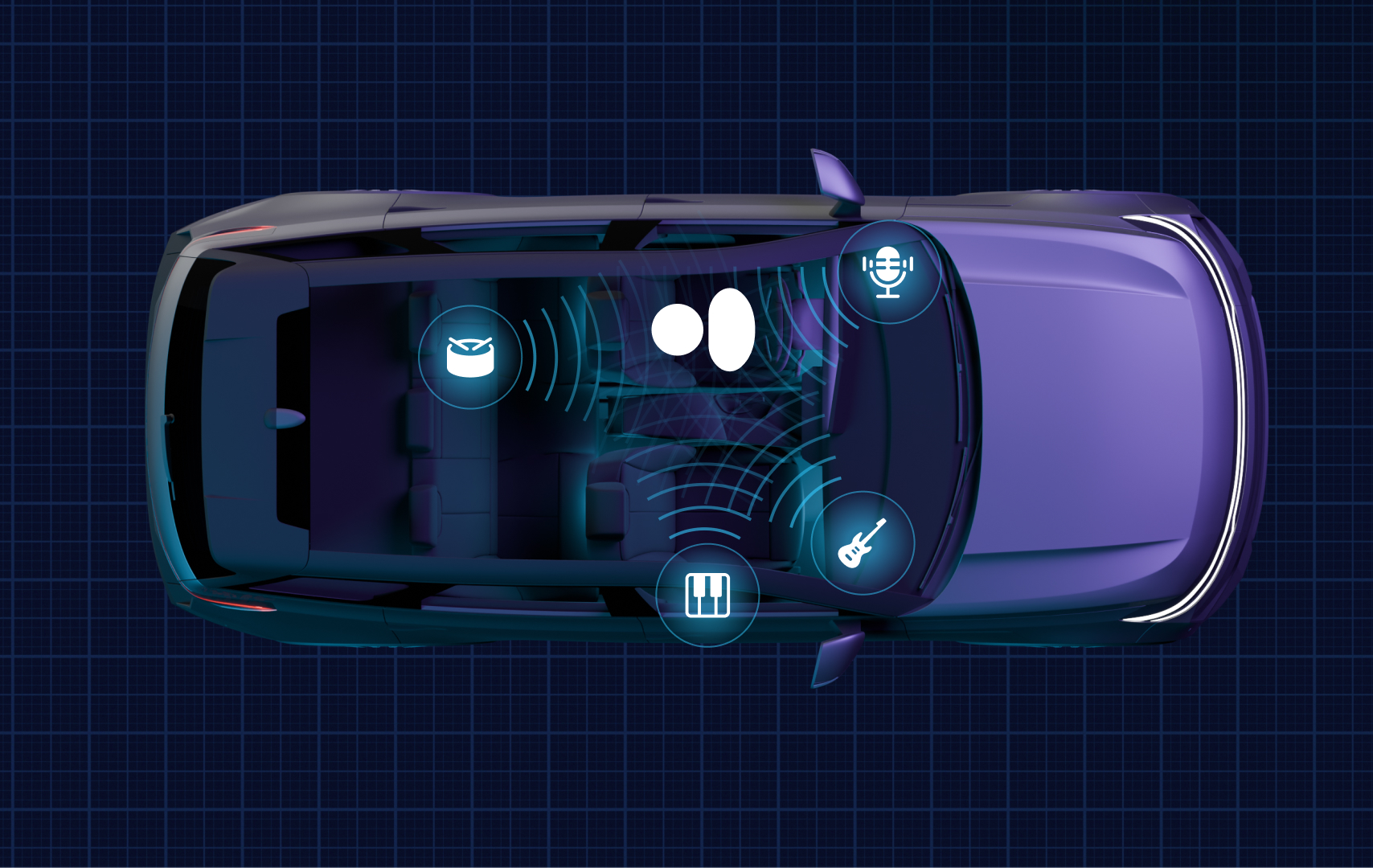
Picture this: you're driving the kids and their friends to school when your boss calls, pulling you into an unplanned conference call with the EU team. The passengers continue watching videos in the back seats while you participate clearly in the business discussion—each audio stream isolated within its zone. To your colleagues, you sound focused and professional. To the kids, the conference call is inaudible. No headphones, no shouting over competing sound, no awkward volume adjustments.
This isn't science fiction. It's what becomes possible when automotive audio engineers have access to GPU-grade, parallel processing power for real-time audio applications.

Breaking Through DSP Bottlenecks
The current automotive audio development cycle is constrained by fundamental limitations. Traditional DSP architectures process audio sequentially, creating bottlenecks that force engineers into trade-offs. OEMs face mounting pressure to deliver premium audio capabilities that differentiate their vehicle features and in-cabin experience while maintaining cost control and avoiding hardware redesigns.
GPU adoption is rapidly growing among automotive OEMs. This growth represents a significant opportunity: transform existing GPU resources into audio processors capable of running advanced algorithms that were previously impossible in real-time automotive environments. The GPU Audio team has developed a solution that unlocks this potential.
The Next Frontier: GPU-Accelerated Audio
Just as GPUs transformed graphics rendering and enabled the AI boom, GPU acceleration represents the next frontier for automotive audio processing. With GPU platforms designed for automotive applications providing the computational foundation for this transformation, audio technology can finally leap forward.
NVIDIA DRIVE AGX offers the perfect combination of parallel processing power, real-time performance capabilities, and production-ready reliability that automotive applications demand. By leveraging NVIDIA DRIVE resources already deployed in vehicles, automotive engineers can implement computationally intensive audio features using as little as 5% of GPU capacity.
GPU Audio's End-to-End Technology Stack
GPU Audio addresses automotive audio challenges through a three-pronged integrated solution:
G.E.A.R.S.: The Key to Innovation
At the heart of GPU Audio's Platform Middleware lies G.E.A.R.S. (GPU Engine Audio Resource System)—a patented scheduler that solves the fundamental challenge of running advanced audio processing on GPUs. G.E.A.R.S. coordinates audio processing tasks across the massively parallel structure of GPUs. This breakthrough enables real-time neural network inference with sub-millisecond latency while maintaining the massive parallel processing advantages that make complex audio algorithms feasible.
The system integrates seamlessly with existing DSP-based vehicle data systems and provides intelligent GPU resource management that adapts to varying computational demands. All without impacting adjacent vehicle systems.
Case Study: Multi-Zone Audio
Now, returning to our work commute/carpool story, traditional in-vehicle audio systems face a fundamental limitation: when multiple passengers want different audio content simultaneously, the competing streams create crosstalk and interference throughout the cabin. This becomes particularly problematic as vehicles evolve toward higher autonomy levels where passenger media consumption increases dramatically.
GPU Audio's Multi-Zone Player module solves this challenge through real-time spatial filtering that suppresses sound between seating positions, delivering isolated audio experiences without crosstalk. The system provides personalized sound at every seat position—a premium audio experience with no additional component costs or speaker redesign required.
Ready to Transform Your Automotive Audio Capabilities?
GPU Audio's technology is production-ready. The Cyber Buck—our mobile acoustic laboratory built on a Tesla Cybertruck platform featuring dual processing rigs and advanced real-time GPU/NPU-based computing is now available for live demonstration. The demo showcases how GPU Audio technology performs in real vehicle environments with customizable acoustic spaces. Contact us at info@gpu.audio to book at Cyber Buck demo in Cupertino, California