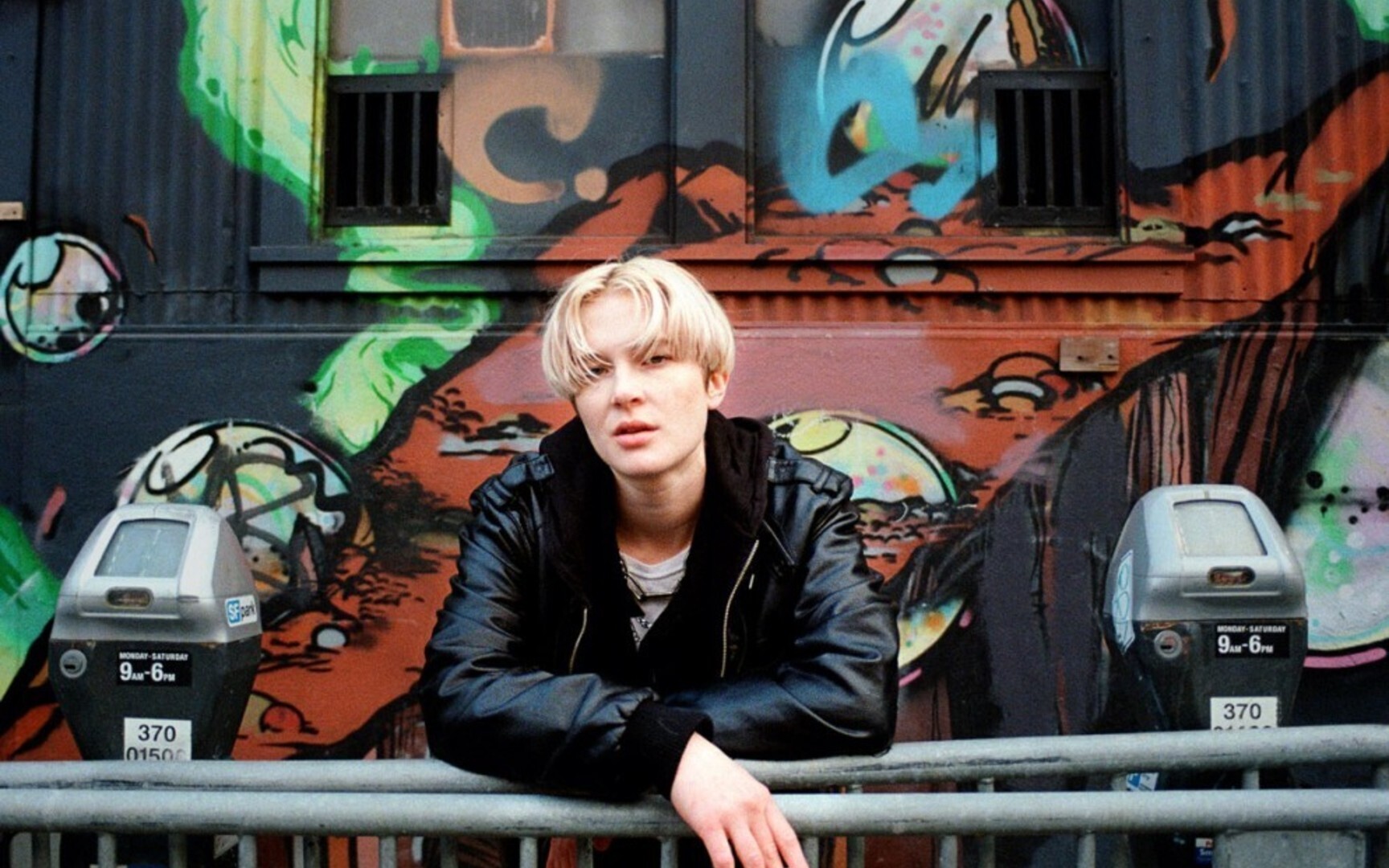
Raised on an eclectic mix of rave CDs from 90s London and New York, Ani Klang has had electronic music pulsing through her since she learned to walk. Growing up surrounded by her Dad’s music collection and instruments, she has spent her entire life experimenting with sound.
The hours spent listening to old underground warehouse legends like Felix Da Housecat, u ziq, stuff from Jungle Sky, Ed Rush and Optical (specifically their record Wormhole), Metalheadz, Trentmoller, and even Massive Attack’s more mainstream album Mezzanine made her fall in love with electronic music. The California-raised, Berlin-honed, international music producer and DJ is a pioneer in experimental club music, creating battlefields of percussion packed with colossal kick drums and mechanical clangs, punctuated by surprising moments of suspense and tension.
Klang learned to create electronic music from her Dad, who built a studio in the family garage when she was young. “I never understood what it was for until I started producing,” explained Klang. “He showed me all his synthesizers (my favorite was his bright red Nord Lead with a gorgeous wooden jog wheel) and his digital audio workstations (back then he had Live 4 or 5 and a super early, ugly version of Logic).”
“I just started out building loops so my brother and his friends would have something to freestyle on, but I immediately fell in love once I got the hang of it,” Klang continued. “If my dad hadn’t given me the essential tools I needed to succeed, my journey would have slowed immensely, and maybe I wouldn’t have had enough material to make a demo reel for college! (I went to the Clive Davis Institute at NYU). Today, he loves the music I make now. I'm always trying to make him proud. He thinks my debut LP is my best piece of work to date which was thrilling to hear.”
This home brewed education helped Klang develop her future career. After graduating from Clive Davis Institute of Recorded Music in 2017, Klang has been hard at work defining her fiercely energetic, hybridized club music that continues to push the boundaries of genre. Named a DJ to watch by Soundcloud in 2021, Ani has created exclusive mixes for BBC Radio 6, Boiler Room, FACT, Inverted Audio, The Lot Radio, No Shade, Scramble.Korea, among others.
Klang released her first full-length, self-titled album this year, a follow up to three EPs including Burn the Empire. Klang released her eponymous record during her third international tour in July of this year, hitting festivals and clubs across Germany, Austria, Czech Republic, Belgium, and the United Kingdom. Now living in Berkeley, California, she has been hard at work running her monthly radio show ‘Klangxiety Attack’ on Reform Radio and writing about an emerging sub-genre of club music she’s deemed, ‘kickmusik.’ GPU Audio – a digital sound processing platform that dramatically enhances computers by offloading CPU processing to its GPU – caught up with Klang to talk about her recent European tour, her new album and the future of music technology. Click to check out more Live AMA's on the GPU Audio YouTube. Join us on Discord. Follow GPU Audio on Social - Facebook, LinkedIn, Twitter, Instagram, YouTube.
Can you tell us about your new album release ‘Ani Klang LP" and your recent European tour?
I sought to explore the fine line between club music and experimental electronic music. I often ask myself, what is the purpose of electronic music? Especially experimental electronic music. What and who is it for and what is it actually doing in the world? This music is considered fringe and for some, quite hard to listen to. So why does it exist if it’s constantly met with such a difficult response? Does it exist to simply be felt and experienced like an audio massage, or a subtle presence to aid an existing experience? Is it just interesting background noise? If no one ever gathers to dance or listen to music ever again, will this music still serve a purpose, and does it have the potential to be timeless? So it’s an amalgamation of experiments meant to fit many moods, settings and hopefully, lifetimes. Time will only tell.
My tour was a massive effort. It was my third international tour so it was very exciting! I made debuts in Vienna, two cities in Belgium (Antwerp and Lommel at Rampage festival) and Prague. I also revisited some of my favorite cities to gig in: Bristol, London, and Berlin. Next year I’d love to go even bigger, maybe finally hit up Eastern Europe!
Can you describe the process of making this latest album? What inspired it?
This album is the result of many rounds of experimentation. I spent a lot of time collecting and manipulating samples, recording every instrument I had from my childhood in my studio, taking advanced sound design tutorials, and learning new sample tracking softwares like Renoise. I even did a few ‘social media cleanses’ so I could fully focus on producing my new record without distractions and alerts. This album underwent many, MANY layers of editing, refining, sculpting, destruction and reconstruction. It was not a linear process at all. I made many small expressions and sketches and boiled them down to the best 10, tightened all their concepts, arranged them in a smoother order and made them all flow together in one cohesive body after they were all created. It was like trying to reinvent human anatomy but instead of starting with the essential organs, I started with the most unnecessary limbs and then wove them into their vital organs at the end.
Most of the tracks on this album were inspired by a new musical concept I’m attempting to pioneer called ‘kickmusik.’ The manifesto can be found on my website (https://www.aniklang.com/kickmusik), but to summarize, it is an emerging form of experimental club music that aims to place the kick drum firmly above melody, vocals, and arrangement as the most elastic and observable element of the composition. This style of production can be heard on tracks like ‘1thousand sadbois (in my mouth)’, ‘daddyo,’ and ‘nature’s drunk.’
What tools do you use to produce now?
Today I try to keep my setup fairly simple so I can keep producing when I’m on the road, so it’s a mostly software-based setup for now. I use Ableton, Renoise, sometimes Logic for mixing, I build a lot of custom racks and ensembles in Ableton and Reaktor 5, which is a pretty old platform but super unique. I’m trying to deepen my knowledge of the tools already in my arsenal, but I am slowly building my collection of plug-ins and hope to one day own some fancy hardware. For live shows I use an Ableton Push 2 with a Steinberg interface. And to record my samples on the road I have a little Sony PCM zoom recorder I love.
How do you choose labels to release on? What are your views on releasing music in the modern world?
Choosing a label is a very important choice, so I look at a lot of factors. I look at everything from the ethos/ethics of the label, how diverse their catalog is, how they split money between label owners and artists, their distribution strategy, marketing strategy, creative consistency with past releases, etc. But to me, the most important thing a label can do is grant creative autonomy to the artist and communicate how best to share their vision with the world.
Where do you see the future of music technology?
There are SO many answers to this question, but I’ll just list the emerging techs I’m most excited about. AI assisted plug-ins and writing assistants are definitely gaining traction - AI is going to assist the production process at every step. I also think we will see a heightened home studio experience with the proliferation of VR and wearable tech (especially if global warming detonates the planet, we’re going to need improved in-home music listening and creating technologies!) So we will definitely see more VR DAW’s emerging and VR/AR assisted collaboration sessions. I also think we’ll continue to see NFT-modeled releases (with single songs being released as one piece of art that is auctioned, owned and appreciates in value). But what’s more interesting to me is the future of music itself, not just the technology that will produce it. The tech is entirely predictable, the sonic patterns and influences we might hear are not.
For more about Ani Klang, check out her website and follow her on Instagram or Facebook. Ask Ani a question in the comments section below.