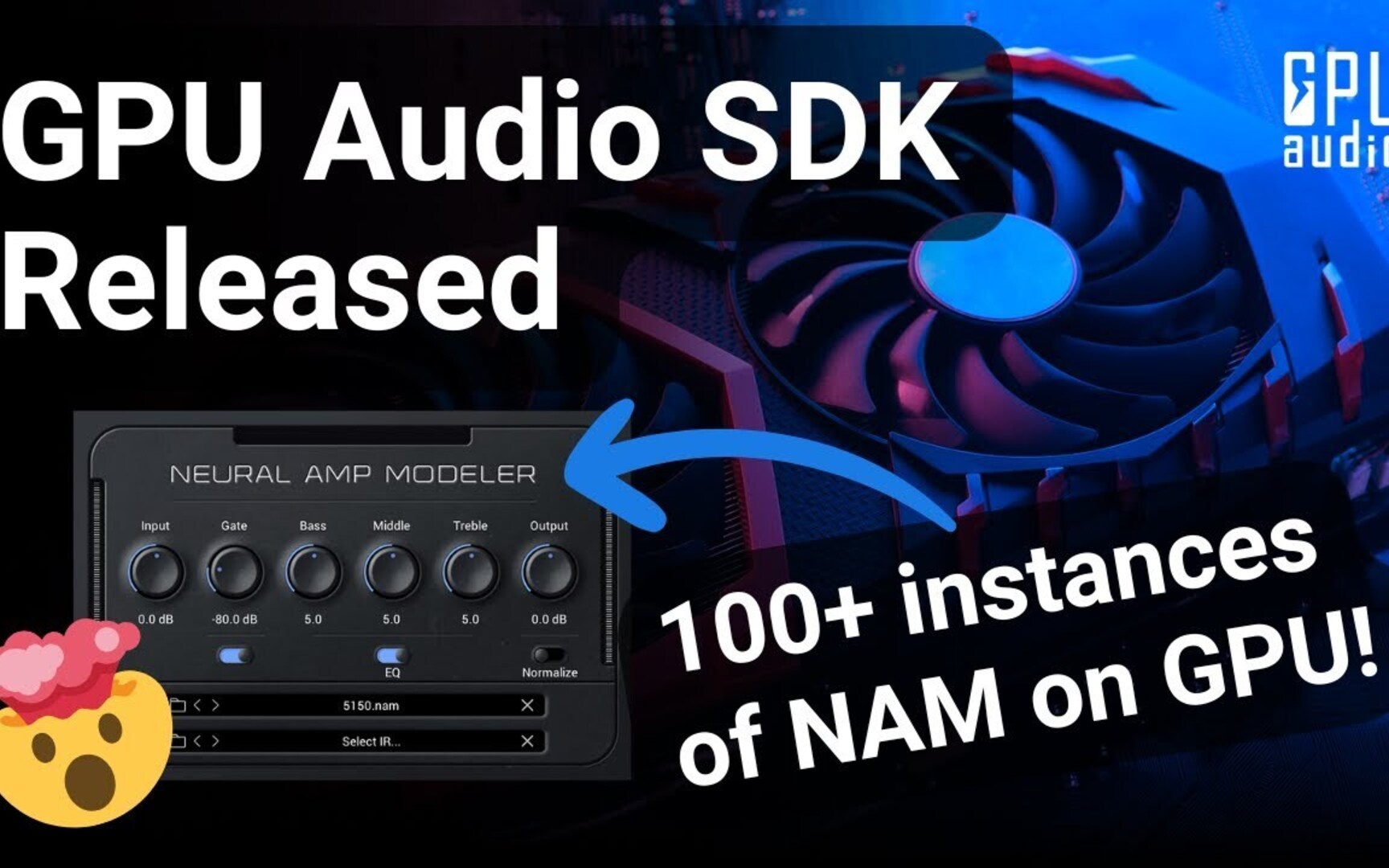
GPU Audio has continued to innovate and accelerate the progress of audio development with a variety of software platforms now powered by our technology, with more to come. During the ADC show in Bristol, GPU Audio held a workshop entitled ‘GPU Powered Neural Audio’ which brought together the upcoming SDK (Software Development Kit) with the possibility of powering over 100 instances of the Neural Amp Modeler (NAM) using the power of your GPU.
The Neural Amp Modeler is an open-source, machine-learning guitar amp modeling software which uses deep neural networks to accurately capture the sound and dynamics of real guitar amplifiers and cabinets. It’s been created by Steven Atkinson and is completely free and open-source - available as a standalone platform and as a VST/AU plugin for DAWs. By integrating GPU Audio’s SDK into the Neural Amp Modeler, the team successfully transitioned the inference process from CPU to GPU, drastically improving performance.
The primary benefit of using GPUs for audio processing is their ability to perform parallel processing on a massive scale. Unlike CPUs, which focus on optimizing single-threaded performance with complex optimizations, GPUs excel at handling multiple threads simultaneously. This makes them ideal for computationally demanding tasks like neural networks and matrix operations, which are critical in modern machine learning-based audio models and integral to plugins like NAM
While modern GPUs are known for their immense computational power, they have traditionally been a challenge to integrate into real-time audio workflows. Using general APIs like OpenCL or CUDA often resulted in latencies too high for real-time audio applications - but GPU Audio technology overcomes this limitation by introducing a custom scheduler, which unlocks the ability to use GPUs for pro audio without compromising real-time performance.
We had the pleasure of speaking about this development process and our LTS SDK with The Audio Programmer, alongside NAM’s creator Steven Atkinson. Watch the complete episode of the Audio programmer below or read on to find how the GPU Audio development team realized this pro-audio milestone.
One of the major technical hurdles in adapting GPUs for audio processing is the need to optimize matrix operations, which are central to machine learning models. This was one of the primary challenges for the GPU Audio development team when porting their core library to GPU. To solve this, they developed custom memory layouts and template specializations, making GPU-lead matrix operations exceptionally efficient across various matrix sizes and platforms. The result is a significant boost in performance for NAM, which can be applied and utilized elsewhere using the SDK.

GPU Audio is making this technology accessible to the community by offering their SDK as both binary and open-source formats. This means that developers can either integrate the technology into their existing audio products or build entirely new audio processing models from scratch. The SDK includes an extensive library of primitives like matrix multiplication, filtering, and convolution operations - all optimized for GPU acceleration. In addition, developers can create their own custom processing functions, making the SDK highly versatile.
The GPU Audio SDK’s integration with tools like NAM provides a straightforward way to harness the power of neural networks in audio applications. By modifying the neural network’s parameters and adding effects chains (such as delays and distortions), developers can create highly customized audio products.
Despite the potential, there are some challenges with the current method of GPU integration within audio. Developers should be proficient in parallel programming and C++-style coding, particularly when working with CUDA. Understanding the intricacies of GPU memory hierarchy and multi-thread synchronization is crucial for getting the most out of the hardware.
Additionally, the current limitations of digital audio workstations (DAWs) in handling large track counts or complex plugin chains can pose challenges. While GPUs excel at accelerating certain audio processes, integrating them into existing DAWs that were not designed with GPU acceleration in mind can lead to bottlenecks in performance. However, as more DAWs adopt GPU acceleration and move forward with the times, these issues will likely be resolved.
GPU Audio has support for Windows, Linux, and MacOS, as well as NVIDIA, AMD and Apple Silicon GPUs, with a unified programming interface - making it an appealing platform for developers in terms of processing power, development, and distribution. This simplifies the development process significantly, allowing developers to focus on their audio models without worrying about the intricacies of different hardware and operating system combinations.
Furthermore, it can also be realized on a range of bespoke hardware from high-end GPUs in desktop workstations to compact devices like NVIDIA Jetson. The ability to run complex audio processing algorithms on small, cost-effective devices opens up exciting possibilities for audio hardware developers, working in a wealth of fields.
GPU Audio’s SDK represents a leap forward in the integration of GPU technology into professional audio processing. By offering a cross-platform, open-source SDK and providing a framework for developers to harness the power of GPUs, GPU Audio is pushing the boundaries of what’s possible in real-time audio. As the technology continues to evolve, it holds the promise of more efficient, powerful, and accessible audio processing tools for creators around the world.
Use cases for the SDK include: Low-Latency Multichannel Processing, Dynamic Spatial Reverbs, Room Simulation, Acoustic Room Correction, Multichannel Sound Synthesis, Real-Time Inferencing of Complex Models and ML-enabled workflows (such as harmonizing multiple instruments), and much more.
Sign up to the GPU Audio SDK by visiting our website.
Find out more about the Neural Amp Modeler here.