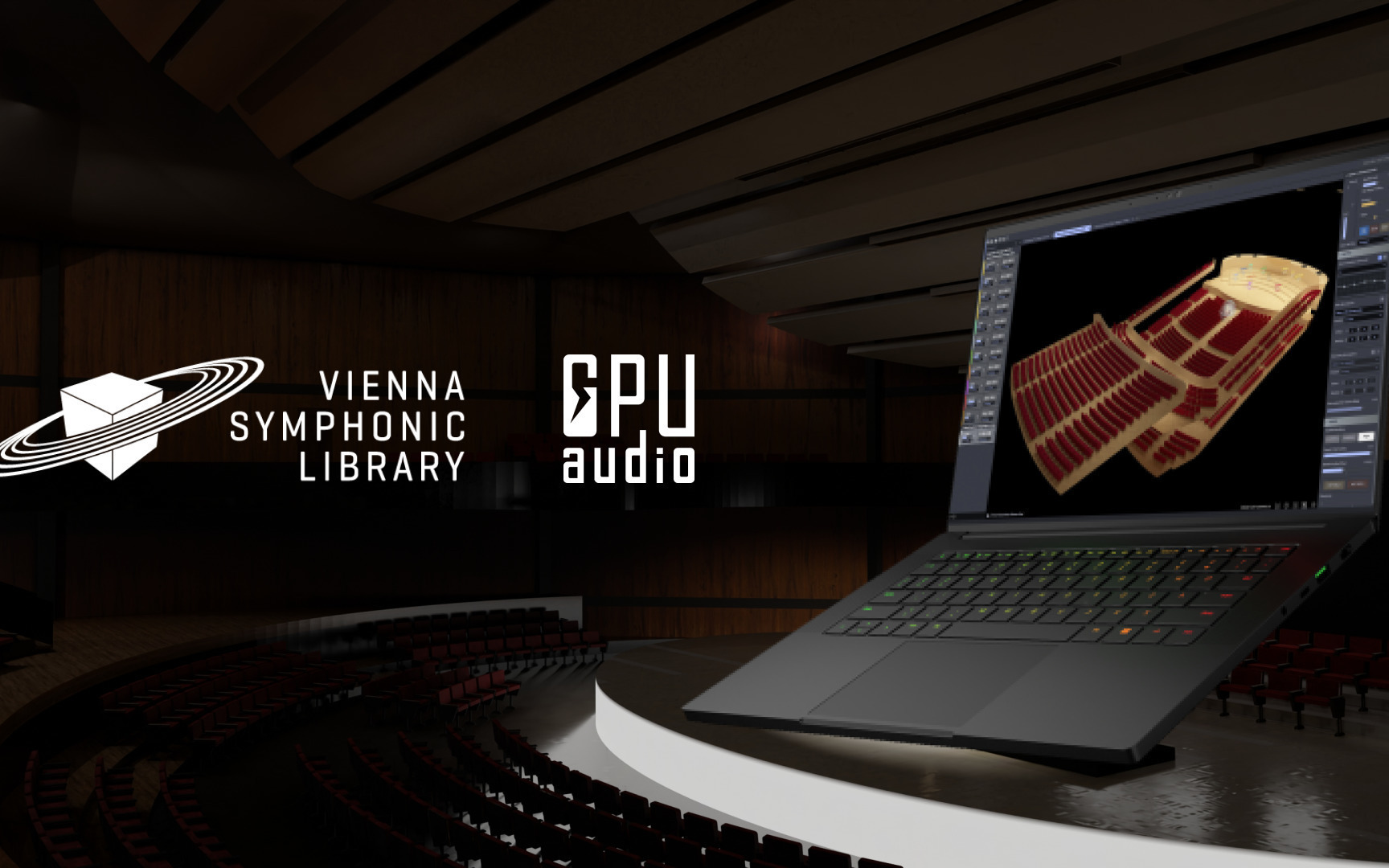
GPU Audio and Vienna Symphonic Library are excited to announce a brand new partnership; unveiling the Vienna MIR Pro 3D Multi Impulse Response Convolution platform powered for the first time by GPU Audio technology. This landmark collaboration sees one of the most established plug-in manufacturers join forces with the company making waves in the audio technology field; processing high fidelity, ultra low latency audio using graphics cards.
The Vienna MIR Pro 3D concept offers a unique, and immersive approach to space as a musical instrument, while ensuring pristine sound quality. It offers direct access to virtual representations of some of the world’s most exciting acoustic spaces with up to four listener/mic positions and virtually unlimited source positions. The collaboration with GPU Audio marks a shift in modern plug-in development, outsourcing huge swathes of in-demand CPU processes directly to the infinitely more adaptable and streamlined graphics card - opening up system resources tenfold, giving musicians less headaches and more creative freedom.
GPUAudio’s CBDO Jonathan Rowden explains: "As a composer myself, the name VSL has always met my ears with a certain reverence - from film and game composers that wanted to bring the absolute peak of quality to their final deliveries. Further enabling the VSL platform to elevate users' musical creativity and results, via acceleration on GPUs, is a natural fit for the technology and a personally fulfilling one for me."
Vienna MIR Pro 3D reframes and redesigns how composers, producers, sound designers, and live FOH engineers interact with their audio platforms. It replaces countless parameters, faders, knobs and engineering know-how with an entirely new graphical concept which allows users to interact more like a conductor than an engineer, to intuitively achieve greater clarity, immersion and authenticity in a mix. MIR’s core engine relies heavily on convolution; a mathematical process that ordinarily pushes the CPU to the limit, with a huge number of sound sources (such as orchestras), multiple output channels (for the likes of 3D audio) and long reverb tails resulting in hundreds, or even thousands of convolutions*. Now utilising GPU Audio’s patented technology in addition to the CPU is a step towards a new dimension of processing power.
VSL’s approach is one of a kind - there’s no other company or platform offering such high fidelity convolution-based virtual rooms with this level of interaction and seamless control. To combine this pro-tier acoustic authenticity and accuracy with the vast processing capabilities of a graphics card provided by GPU Audio is truly a paradigm-shifting moment for the industry.
This is the first 3rd party plug-in release announced which utilises GPU Audio’s patented technology. Find out more about the GPU Powered Vienna MIR Pro 3D here. Sign up to be notified of the release here.
Vienna MIR Pro 3D Features and Benefits:
* For example: An orchestra made up of 80 stereo sources, mixed in 7.0.4 for Dolby Atmos, will create a maximum of 1,760 positional impulse responses and consequently the same number of convolutions (80 x 2 x 11).